


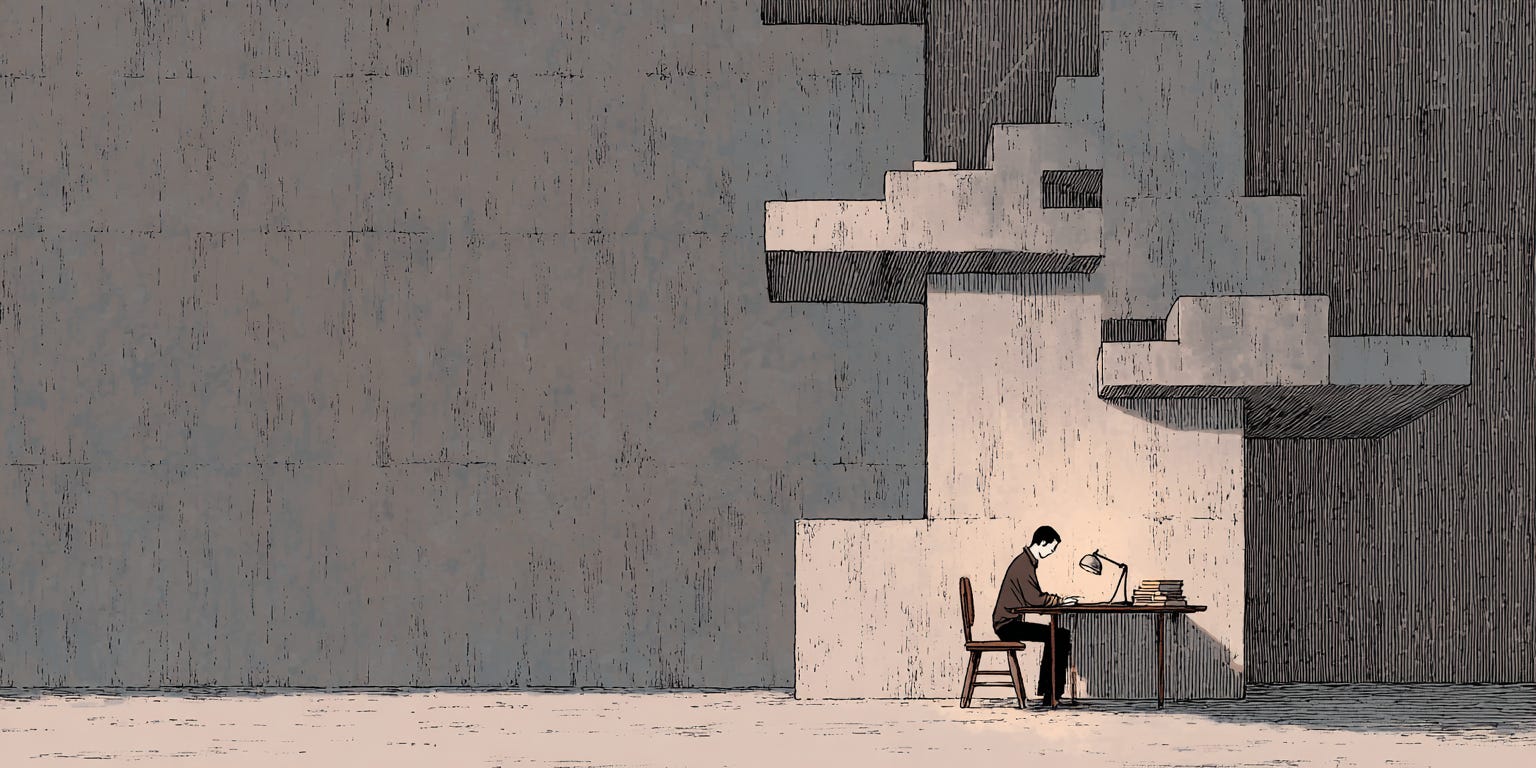
I pivoted hard into fiction this year and continued my long-stalled study of the craft of writing novels and short stories.
I expected it to slow down my non-fiction output while I learned something new.
Instead, it made my articles and emails sharper, more vivid, and harder to click away from.
Here are twelve lessons from fiction that changed how I write everything else.
1. Open in the middle of something happening.
Fiction writers call this “in medias res,” meaning dropping the reader into the action rather than building up to it.
Most non-fiction opens with throat-clearing and context-setting that loses people in the first three seconds.
Start with the moment, the tension, or the problem already in motion and fill in the background later.
Your reader decides whether to stay in the first two lines, so make those lines feel like walking into a scene already underway.
2. Every sentence must earn its place or get cut.
Fiction taught me that filler is death, and readers feel it even when they cannot name it.
A sentence that restates the previous one, adds nothing new, or exists because you liked the sound of it will make readers drift.
I now read every paragraph, asking whether each line pulls weight or just takes up space.
Cutting twenty per cent of your draft almost always makes the remaining eighty per cent land with more oomph.
3. Concrete details beat abstract claims every time.
“He was nervous” is weak, but “he kept checking the door” shows you something real.
Non-fiction writers love abstractions like “consistency matters” or “mindset is key” and these phrases slide off readers without sticking.
When you replace a vague claim with a specific image or example, the reader sees it in their mind and that image stays.
Fiction forced me to show rather than tell, and my non-fiction became more persuasive the moment I applied the same rule.
4. Withhold information strategically to create pull.
In fiction you learn that giving the reader everything up front kills their reason to keep reading.
You drop hints, raise questions, and delay the full reveal until the tension has built.
Non-fiction writers dump all their value in the first paragraph and wonder why nobody finishes the piece.
I started structuring articles the way I structure stories, with an open loop at the start that only closes at the end, and completion rates climbed.
5. Your reader needs to feel something, not just learn something.
As Stephen King wrote, “I try to create sympathy for my characters, then turn the monsters loose.”
Information alone does not move people or make them remember what they read.
Compare “procrastination reduces productivity” with “I sat there for three hours refreshing Twitter while the cursor blinked at me, and by the time I finally wrote a sentence, the day was gone and I hated myself a little.” The first is a fact you already knew, and the second is a feeling you recognise in your chest.
Fiction taught me that emotion is the delivery mechanism for meaning, and if you want your ideas to land, you have to make the reader feel the problem before you offer the solution.
I stopped writing to inform and started writing to affect, and the difference showed up in every metric I track.
6. Conflict makes people care.
Every story needs friction between what a character wants and what stands in the way, and non-fiction works the same way.
If you write about a solution without first making the reader feel the weight of the problem, your advice floats in a vacuum.
7. Your voice is your only real competitive advantage.
Raymond Carver said, “That’s all we have, finally, the words, and they had better be the right ones.”
Fiction taught me that two writers can tell the same story and produce completely different experiences based solely on their voice.
Non-fiction writers chase trends, formats, and templates while ignoring the one thing that cannot be copied.
When I stopped trying to sound professional and started writing the way I actually think, people began recognising my work without seeing my name attached.
8. Subtext does more work than text.
In fiction, what a character does not say often matters more than what they do say.
Non-fiction writers tend to over-explain, spelling out every implication as if the reader cannot be trusted to connect dots.
I learned to leave room for the reader to participate, to arrive at conclusions I pointed toward rather than handed over.
Writing that respects the reader’s intelligence creates a feeling of discovery, and discovery is what makes ideas stick.
9. Endings should resonate, not just conclude.
A good story ends in a way that echoes backwards through everything that came before and forward into the reader’s thinking.
Most non-fiction just stops, often with a generic call to action that feels bolted on.
I started treating my final lines like the last image in a film, something that lingers after the screen goes dark.
Your ending is the last thing the reader carries with them, so make it worth remembering.
10. Transformation is the spine of anything worth reading.
In fiction, a character who ends the story unchanged is a character who wasted the reader’s time.
Non-fiction works the same way, whether the transformation happens to you in the backstory or to the reader by the end.
Every piece I write now has a clear arc from old belief to new understanding, and that arc is what gives the piece shape.
11. Cut your favourite line if it does not serve the piece.
Writers call this “killing your darlings” and it means removing the clever phrase or beautiful sentence that you love but that distracts from what the piece needs to do.
I have cut lines I spent ten minutes crafting because they were showing off rather than serving the reader.
Your loyalty belongs to the piece, not to any individual sentence, and the willingness to cut good writing for the sake of better writing separates amateurs from professionals.
The draft is not a museum for your favourite sentences. It is a machine that requires every part to work toward the same purpose.
12. Make the reader curious before you make them informed.
Fiction hooks you with questions before it provides answers.
That sequence is not accidental.
The brain is wired to seek closure on open loops, so if you raise a question early, the reader will stay to find the resolution.
Non-fiction writers love to lead with the answer, which removes the only reason someone has to keep reading.
I restructured my articles to pose the problem vividly before revealing what solved it, and people started reading all the way to the end.
Fiction and non-fiction are not as separate as I thought, and the lessons transfer in both directions.
If you want to write non-fiction that holds attention, study how storytellers have been doing it for thousands of years.
The craft is the same; only the surface changes.
By the way, you can read my fiction stories at my Story Cabin Substack here. A subscribe is appreciated!
Alex
By the way, do you want to go deeper into ideas like these and apply them so your audience grows?
My Online Writing Alchemy course shows you how to master writing things that resonate better than 99% of online writing slop.
When you do, you’ll regularly enjoy that warm, fuzzy feeling of readers sending you emails of thanks.
Write something daily. Post it. You’ll have an asset few will enjoy in the coming years.
You can also join us as a paid subscriber so you can support me as a writer, and access all the locked, archive posts to help take your writing and brand-building to higher levels:
I learned something at every point, thanks for sharing!
Best advice I have read in a long while. Looking forward to applying it. Thank you!